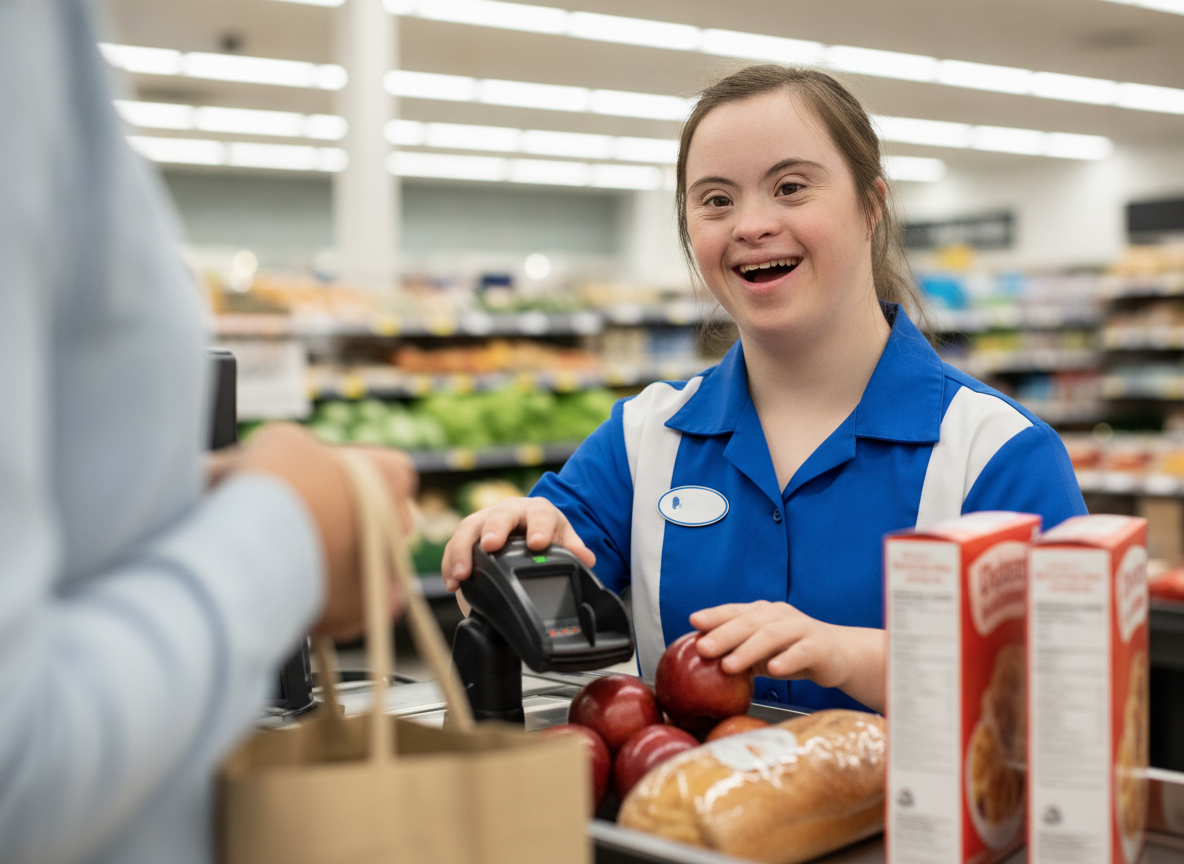
In partnership with the University of Minnesota, Unified Work drew on existing academic literature to inform our course design. Discover how evidence-based strategies for disability employment inspired our training approach.
October is National Disability Employment Awareness Month. This year’s theme is Celebrating Value and Talent.
Celebrating is the easy part. Showing that your work actually helps is harder. It takes time, data, and someone willing to tell you when something is not working.
That is why Unified Work asked the University of Minnesota’s Center for Applied Research and Educational Improvement, known as CAREI, to look closely at what it does.
An outside eye, on purpose
CAREI is a research and evaluation center at the University of Minnesota. Since the 1980s, it has helped organizations assess their practices, measure impact, and continuously improve their work.
Kim Gulbrandson is CAREI’s associate director of effective practices and evaluation. Kim’s team helps organizations define their goals, map how to achieve them, and refine their approach along the way.
“Evaluation helps you see what’s working as you build,” Kim said, “so you can refine things along the way instead of waiting years to find out.”
Kim is direct about what an independent evaluator is for.
“Sometimes people say, ‘We want an outside partner to validate what we do and show it works,’” Kim said. “Our role isn’t to stamp approval. We can’t promise what we’ll find before we do the evaluation. We can definitely look at whether a program works, but we have to wait and see what the evidence actually shows.”
That is the point. An organization that only wants a rubber stamp does not invite independent researchers in. Unified Work did. For Unified Work, the goal of bringing in CAREI was simple: use academic research to strengthen course design from the start.
Why the work matters
Research is clear that a job is about more than a paycheck. For people with disabilities, work is linked to a stronger sense of purpose, more social connection, better mental health, and higher life satisfaction.
People with disabilities also say they want to work. The gap is not desire or talent. It is access, support, and employers willing to look closely.
Read: More Than a Paycheck
Built on evidence, not instinct
Most training programs are built on what feels right. Unified Work’s curriculum was built on a crosswalk.
Starting in 2024, CAREI mapped the skills that matter at work against trusted national sources. These included the US Department of Labor’s Skills to Pay the Bills, the Council for Exceptional Children, the Workforce Innovation Technical Assistance Center, and CAREI’s own review of the literature.
The result is a curriculum map with five areas of focus:
- Career exploration and goal setting
- Finding and applying for jobs
- Working with others
- Workplace skills
- Taking care of yourself
Each area breaks down into specific learning objectives, more than 70 in all. Every one answers a simple question: how would we know a person has learned this skill?
The first objective in the map is telling. Before anything else, each learner names at least one strength and one interest. The work starts with what people bring.
The courses are also written to be accessible first. The primary audience reads at a first to third grade level, so the material is built for that from the start.

What we discovered
CAREI turned its review into five short articles. Three findings stand out this October.
Soft skills open doors. In one survey of employers, social skills were named more often than technical ability as the reason a candidate with a disability was not hired. That tells us where support makes the biggest difference. Communication, teamwork, and dependability sit at the center of Unified Work’s training.
Read: Essential Components of Employability
How you teach matters. Research supports both in-person and online training. Hybrid training, which blends the two, showed higher satisfaction and more confidence in soft skills than fully in-person training. Fully self-paced online training can make it harder to stay engaged. Unified Work uses in-person and hybrid formats for its live courses.
Read: Selecting Effective Modes of Employability Training
Before and after the first day. The most effective programs do not stop when someone is hired. They build skills before the job and keep building them after it starts.
Rather than relying on classroom preparation alone, the University of Minnesota’s Institute on Community Integration (ICI) emphasizes identifying individual strengths, matching people to the right workplace, and coaching skills directly on the job. “It’s not about training in isolation and hoping for the best,” Kim said of ICI’s approach. “Real progress happens when training is paired with actual job opportunities, using a person’s natural strengths to match them to the right role and building skills on the job.”
You can see this in the other stories we are sharing this month. Asher Kujawa spends 12 weeks getting to know each person before building a job around them. At Project SEARCH, interns learn inside a working hospital, on real tasks, next to the people who may hire them.
Unified Work is built for both halves. Its courses, currently free, help people explore what fits and get ready to apply. They are just as useful once someone is working. Courses like Boundaries at Work and Emotional Intelligence help people grow in the job they have and speak up for what they need.
Learning does not stop on the first day. It should not have to.
Read: Why Employability Training Is Essential
Read: Instructional Approaches to Teaching Employability Skills
Start with strengths
One piece of the partnership fits this year’s theme almost word for word.
It started as an employability index, a way to measure how ready someone is for work. As the work went on, the idea turned around. It is becoming a Strengths and Skill Discovery Profile.
The difference matters. An index asks what someone lacks. A profile shows what they bring.
The goal is a one-page profile that belongs to the person, not the employer. Kim described it as a page that says, “Here’s where my strengths are. Here’s what I offer and bring.”
It also provides areas to continue their growth. With support, a person can use it to create a resume or bring it to a job coach, a teacher, or an interview. That is value and talent, on paper.
CAREI also drafted a self-assessment that works the same way. It asks people to picture themselves at work and rate what they can do. Some items are about getting a job. Many are about thriving in one:
- Stand up for myself.
- Ask for help when I need it.
- Know my basic rights under the Americans with Disabilities Act.
People can retake it as they learn and watch their scores grow. It points each person to the courses that fit them, whether they are job hunting or already working.
Both tools are still in development. Unified Work is working toward offering them on its eLearning platform.
Everyone is employable
Minnesota already agrees with this idea. In 2014, the state adopted an Employment First policy. It sets the expectation that people with disabilities can work, and that competitive, integrated employment is the first option, not the last.
“It really assumes everyone is employable with the right supports,” Kim said.
The question is not whether someone is employable. It is what support they need. When readiness becomes a test someone has to pass before they are allowed to work, the test becomes the barrier. Kim called it “an unintentional gatekeeping barrier.”
What serious looks like
The work is not finished. CAREI also built a logic model, a theory of change, and an interactive map of the barriers that stand between people with disabilities and a job. The formal evaluation, checking whether Unified Work’s activities lead to the outcomes it is aiming for, is still in discussion. The logic model and theory of change would guide that evaluation if it moves forward.
The barrier map shows why that matters. No single program can move every barrier. Unified Work’s next step is to use the map to show where it moves the needle most.
That is the honest answer, and it is the point. Organizations serious about impact define it, build on evidence, and ask someone independent to check. Unified Work has done the first two. The third is still being discussed.
This October, we are asking employers to do one thing: interview one candidate with a disability. The research points to where to start. Believe the person is employable. Look at what they bring. Then build the skills together. Reach out to Unified Work for assistance.
Learn about Minnesota’s Employment First policy at mn.gov/dhs
Learn about CAREI at carei.umn.edu
Looking for work or growing in a job you have? Start a free course at unifiedwork.com